

Not long after the Messiah of Satoshi, the Innovators started to pop up. They called themselves blockchain builders and began launching Decentralized Networks, which were claimed one day to replace the traditional financial systems.
The traditional systems were rooted in centralized control and government oversight, which limited the Innovation of and for the free people.
Per the records available, it is unclear what prompted the Innovators to change their priority and seek enterprise partnerships and government regulation — the official documents state terms like institutional access, business predictability, consumer protection, and customer needs — …
The elders say that throughout human history, this particular story has repeated itself over and over again, stemming from an organic process called consolidation.
Story
I got myself some WBTC on the Osmosis chain which I stored in a non-custodial wallet called Leap. It was an experiment after which I had been lazy for about a year, and it was time to move the WBTC back to BTC.
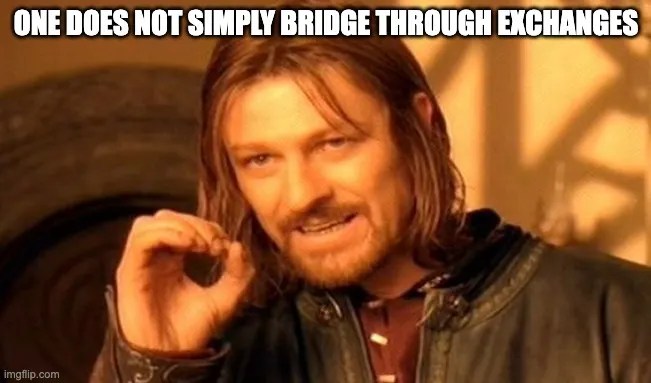
The easiest way to “bridge” from Osmosis to Bitcoin, I now know, is through an exchange like Binance. You just 1. swap your WBTC to Osmo (WBTC is not accepted on Binance); 2. send that Osmo to an exchange; 3. exchange it for BTC; 4. and send that BTC to your Bitcoin wallet.
But that’s not what I did… If you watched the Lord of the Rings, you should remember a puzzling character by the name of Boromir, who was first holding onto the ideals of protecting his homeland (bridging through web3 tech) so he embarked on an almost impossible two-month (two-hour) journey with Frodo to only later be tempted by the powers that the Ring (exchanges) gives, attempting to kill Frodo.
“What was this guy’s goal anyway?” I kept wondering every time I watched the first episode.
My goal was to find the simplest way to swap the WBTC sitting in my Leap wallet on Osmosis for native BTC on Bitcoin. And I failed.
#1. Don’t blame bugs!
It is after going through the nine circles of hell that I realized that bugs — even though they crawled on me uncomfortably often while I was busy releasing the prisoner — are not the core problem.
I saw that Leap wallet had that third-party bridge embedded in its interface, I saw many other things that looked straightforward but were not. At some point, I started writing them down to ensure I don’t lose track of the wondrous spectacle of issues!
#2. Don’t use the bridge within the Leap wallet!
As simple as the problem may be, that bridge inside the Leap wallet never connected to the Leap wallet (integration failed).
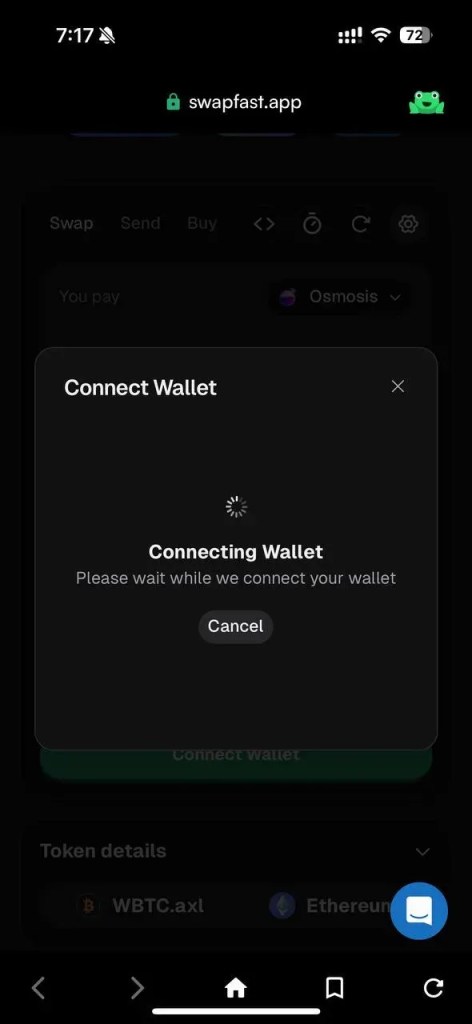
Try explaining to a regular Chase app user that their investment account (JP Morgan) is not responding, so they should try to go to the JP Morgan website directly and try to connect their Chase account from the other side.
#3. Don’t expect AI to know the real deal!
I actually hoped AI would give me a shortcut, as it often does lately, but when it came to giving advice on the crypto tech, it turned superficial and too much of a visionary.
I did a quick research, a little less superficial, and learnt about a few options that I had:
- Gravity Bridge Portal, which seemed like a retail-facing bridge and had no wrappers, so I preliminary chose that route.
2. Axelar, which is more of an infra for other bridge developers to build retail-facing bridges, but weirdly, Axelar doesn’t list them on its website (well, maybe somewhere in the blog they do. “I don’t have time to read blogs!”).
3. Nomic — a more of its own chain between Bitcoin and Cosmos, but in order for you to bridge, the intermediate step was to swap WBTC for NBTC (Nomic’s wrapper), which seemed excessive. After all, I was trying to get rid of wrapped BTC, not swap it for another one.
#4. Don’t use WBTC issued by Axelar!
My WBTC was issued by Axelar, which, as Gravity Bridge framed, “is the only correct next destination”, whatever the fuck it was supposed to mean. I was starting to get angry.

Basically it meant “we won’t bridge your WBTC because we chose not to have liquidity for the assets issued by the Axelar company.”
(Pro tip: swap to the Osmo token and bridge to Ethereum with no problem. Unfortunately, I wasn’t there to give me that advice.)
Having realized my WBTC is issued by Axelar, I reached out to my friend who works there because I could not remember what Axelar-enabled bridge I used a year ago when I bought that WBTC, so I was hoping an Axelar employee would tell me what to do.
While waiting for his response, I found myself craving for a short solution as well as a way to sublimate my anger, so I wrote this message to one of the chats with crypto friends.
 Bogdan Bitcoinovich